Surge in EV Battery Production—Contact-less Laser Marking Demand Rising Globally
Introduction: Why EV Growth Means More Laser Marking
The global shift toward electric vehicles (EVs) is rewriting the rules of manufacturing. With EV battery demand crossing 950 GWh globally in 2024 and projected to double by the early 2030s, manufacturers face an urgent challenge: ensuring quality, safety, and traceability at scale.
This explosive growth has created a parallel boom in contact-less laser marking systems—a technology that delivers speed, precision, and permanent identification without consumables. For EV battery makers, traceability isn’t optional—it’s critical.
What is Contact-less Laser Marking on EV batteries?
Laser marking is a way of putting permanent, high-contrast marks / engravings on different materials—like Cu, Al, steel, coated/insulated foils, films, plastics, separators.
Unlike inkjet printing or mechanical methods, lasers don’t need inks, chemicals, or consumables. That makes the process faster, cleaner, environment friendly and more reliable.
Here’s why it’s becoming the go-to solution for EV battery makers:
· Built to last: Marks stay visible and sharp, even when exposed to abrasion, heat, or harsh chemicals.
· Contact-free: The beam never touches the surface, so there’s no risk of damaging delicate parts.
· Fast & scalable: Perfect for high-speed production lines, especially in battery gigafactories.
· Eco-friendly: No inks, solvents, or waste—just precision.
For EV battery production, where quality, speed, and traceability can’t be compromised, contact-less laser marking and engraving by Markolaser laser machines and automations, is the clear winner.
Types of Lasers Used in EV Battery Manufacturing
Laser choice depends on material to be marked or engraved, speed requirements, and sensitivity and precision requirements, making multi-wavelength capability essential for EV battery manufacturers.
Depending on these factors , Fibre lasers, UV lasers, CO2 lasers or Green lasers can be put to use. Contact us for a more detailed discussion .
Applications of Laser Marking, engraving , cutting and welding in EV Battery Manufacturing
- Traceability & Serialization
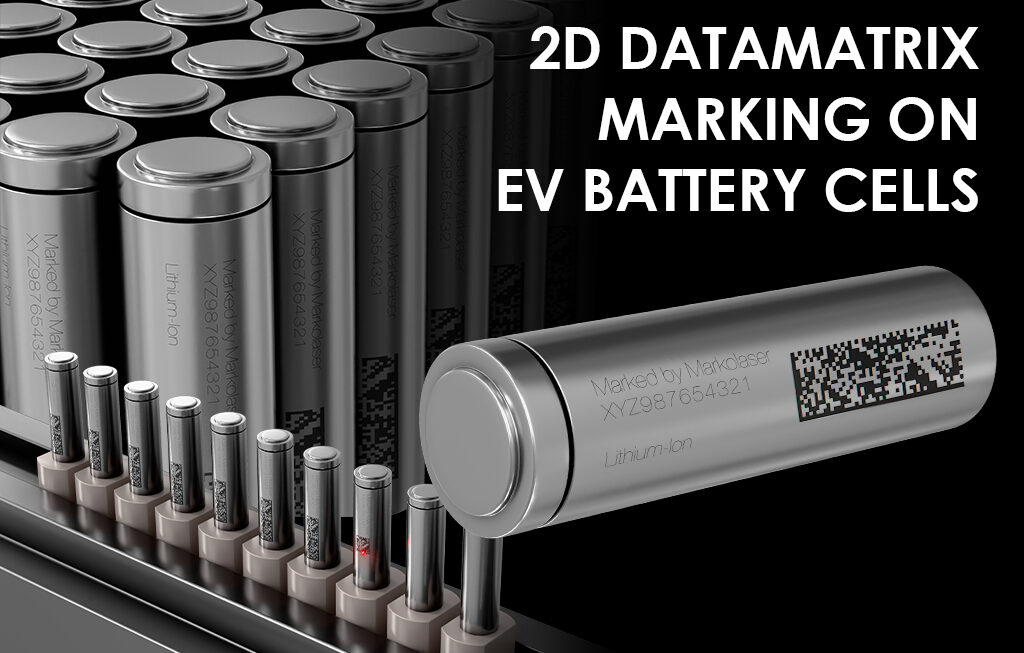
- Unique QR codes, DataMatrix, and serial numbers on cells, busbars, and modules.
- Surface Preparation & Cleaning
- Coating removal (e.g., enamel from copper hairpins).
- Pre-weld cleaning to ensure strong electrical connections.
- Cutting & Welding Support
- Laser processing of foils, tabs, and housings.
- Branding & Aesthetics Logos, safety markings, and compliance codes on housings. Also machine vision to verify marks, ensure readability and detect the defects for accurate traceability.
What EV Battery Manufacturers Expect from Laser Providers
EV battery makers demand turnkey solutions that deliver:
- High-speed performance – On-the-fly marking without slowing production.
- Material versatility – Metals, plastics, films, and coatings.
- Zero damage and defects– Especially for thin foils & separators.
- Smart integration – Compatibility with automation, MES, and smart Industry 4.0 systems.
- Reliability & uptime – Robust optics, minimal maintenance, global support.
- Compliance & safety – Class-1 laser safety enclosures, regulatory traceability standards.
- Sustainability – Energy-efficient, additive-free, eco-friendly marking.
Providers like Markolaser solutions who can combine laser technology + automation + software will stand out in the EV battery supply chain.
EV Battery Passports (EU 2023/1542) are mandatory from 18 Feb 2027.
Laser-marked QR/DataMatrix codes ensure permanent, scannable, traceability ready
across cells, modules, and Battery packs.
| Laser Type | Best for Material | Verification Grade |
|---|---|---|
| Fiber | Metals (aluminum, steel, busbars) | A–B |
| UV | Polymers, foils, thin films | A–B |
| Green | Plastics, coated metals | A–B |
Challenges in Laser Marking, welding, cutting and engraving for EV Batteries
- Material variety: From copper foils to coated separators, no single laser fits all.
- Balancing speed vs quality: High-resolution codes can slow the output
- Thermal sensitivity: Risk of damaging thin materials.
- Data ecosystem integration: Traceability only works if marking + reading + data logging are seamless.
These challenges highlight why innovation in lasers, optics, and software is crucial for future EV gigafactories.
FAQs About Laser Marking in EV Battery Manufacturing
Q1. Why is contact-less laser marking preferred in EV battery production?
Because it provides permanent, non-consumable, and high-speed marking without damaging sensitive materials.
Q2. What kind of codes are typically used on EV batteries?
DataMatrix, QR codes, and serial numbers for full traceability across the supply chain.
Q3. Can laser marking damage thin foils or separators?
With UV and short-pulse lasers, thermal impact is minimized, preventing damage.
Q5. How do laser providers ensure reliability?
By offering enclosed, Class-1 systems, preventive maintenance, and integration with MES for data-driven manufacturing.
Q6. Is laser marking environmentally friendly?
Yes – laser marking is an additive free marking. No inks, solvents, or consumables are required, making it highly sustainable.
Q7. Where is the traceability for digital passport in EV Batteries required?
The EU requires a QR-linked digital passport for EV batteries from February 2027. India is moving toward similar transparency. Markolaser machines are fully equipped to handle such battery passport requirements.
Q8. Who are best laser marking machine supplier in Bangalore for EV battery marking?
Markolaser laser marking stands out as the provider of best laser marking solutions for QR code, datamatrix , traceability and serialization, on cells, bus bars and modules.
Q9. Which codes are recommended for packs/modules?
QR or DataMatrix codes, verified to ISO standards.
Q10. Why choose laser over inkjet/labels?
Because laser marking is permanent, does not peel off, environment friendly and does not fade.
Q11. Which laser type suits which material?
selection of laser depends upon the chemistry of the material. fibre lasers for metals, UV lasers for polymers and foils.
Conclusion: The Future of EV Batteries Depends on Smart Laser Solutions
As EV adoption accelerates, battery manufacturers face mounting pressure to scale fast while maintaining quality and compliance. Contact-less laser marking is at the heart of this transformation—enabling traceability, improving safety, and ensuring sustainability.
For laser providers, this is more than a growth opportunity. It’s a call to innovate, integrate, and deliver solutions tailored to the unique challenges of EV battery manufacturing. At Markolaser, we believe the future of e-mobility will be driven by precision, reliability, and innovation—and laser technology will be at its core. We are providing laser marking solutions to EV Mobility industry at Baddi, Chennai, Bangalore, Haryana, Pune and all other automotive manufacturing hubs in India, Germany and USA.
Learn more about Markolaser’s advanced laser marking solutions for EV batteries.