

Laser Process — Micro-Drilling

Holes as small as 70 Micron.
Minimum taper. Zero tool Wear.

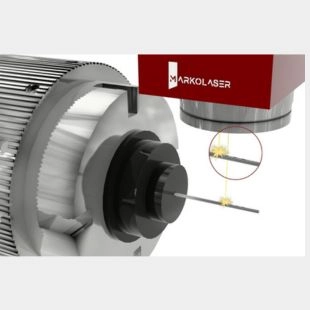
Markolaser's laser micro-drilling systems pierce metals, plastics, and medical-grade components with tolerances that the mechanical drill bits physically cannot reach , Contactless, no wear and tear , no minimum size limit.

1µm–1mm
Hole diameter range
20–50W
Fibre laser power
0
Tool wear

Laser micro-drilling is a non-contact process that uses focused, high-intensity laser energy to remove material at a single point and create precise holes ranging from 1 micron to 1 millimetre in diameter. Because there is no physical drill bit, the process achieves tolerances far tighter than mechanical drilling, with no tool wear and Minimal taper making it the standard method for filters, fuel injector nozzles, and medical implants and tubes that require extremely fine, repeatable holes.

How Laser Drilling Works?

Four stages, one continuous laser pulse sequence. The laser's energy is concentrated on a single point to progressively remove material and form the hole — the exact removal mechanism shifts depending on material, laser type, and process configuration.

01 — Focus ( pre heating)

Beam Focus

A fibre laser beam is concentrated to a sub-micron spot size directly on the target point of the material surface. The material remains solid in this state.

02 — Melting and vaporisation

Controlled Energy Delivery

High-intensity pulses heat and melting the material at the focal point, drilling deeper with each pulse.

03 — Phase transition

Boiling & Vaporisation

The solid structure becomes a liquid melt pool and reaches its boiling point causing evaporation and vaporisation.

04 — Ejection & Hole creation

Material & removal

Vaporised and molten material is ejected from the hole, assisted by gas flow to keep the channel clean and taper-free.

What is laser micro drilling?

Laser micro-drilling is a non-contact process that is used for hard to mill materials. It uses high intensity laser power to remove material at a single point and create precise holes ranging from 30 micron to 1 millimetre in diameter*. Since there is no mechanical drill bit, the process achieves much tighter tolerances, with no tool wear and minimum taper — making it the best drilling method for filters, fuel injector nozzles, and medical implants and tubes that require extremely fine, repeatable holes.

Which drilling method should I use?

Laser micro-drilling vs. mechanical drilling

Parameters LASER MICRO-DRILLING MECHANICAL DRILLING
Minimum hole size Minimum hole size 1 micron ~100 microns (limited by drill bit) ~100 microns (limited by drill bit)
Tool wear None - no physical contact Yes - bits wear and break
Taper Minimum Diameter narrows with depth
Mechanical stress on part None Yes - risk of cracking thin walls
Suitable for < 0.5mm wall thickness Yes - 50W fine laser Difficult or impossible
Drilling Speed Ultra-fast; up to thousands of holes per second. Slower; limited by mechanical feeding and retraction.
Material Limits Struggles with highly reflective/transparent items. Struggles with ultra-hard alloys and brittle ceramics.
Primary Defect Risk Thermal damage: Heat-affected zones, melting Mechanical damage: Delamination, burrs, micro-cracks.
Operational costs Massive upfront investment. No consumable costs. Low initial investment. Massive operating expenses
Geometry & aspect ratio Can drill tapered holes, blind holes, non-circular geometries and blind micro-reservoirs can only create straight, round, flat-bottomed, or through-holes.
Best for Medical implants, filters, nozzles, fine mechanical parts Larger holes, lower precision requirements

Industries served

Where micron-level precision is non-negotiable

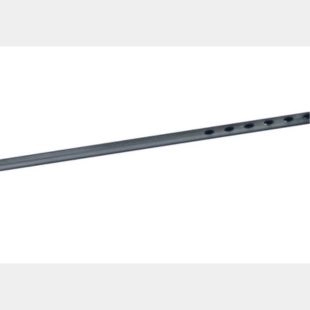
Medical implants & tubes

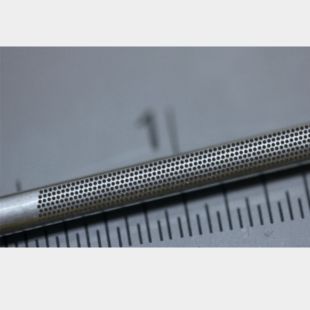
Drug-eluting stents, catheter tubes, and surgical implants requiring biocompatible, burr-free holes.

Fuel injector nozzles

Precision spray-hole geometry for automotive fuel and emission systems requiring exact flow control.

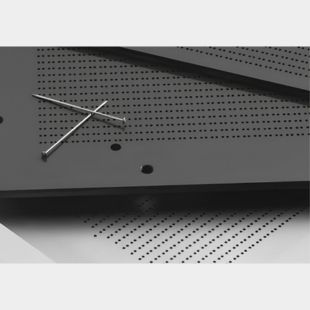
Filter meshes

Uniform micro-perforation patterns across metal and polymer filter media at high throughput.

Aerospace cooling holes

Turbine blade and component cooling channels requiring exact diameter at extreme tolerances.

Electronics & sensors

Micro-vents and pressure-equalisation holes in sealed electronic and sensor housings.

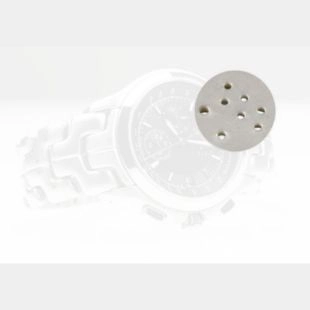
Fine mechanical parts

Watchmaking, precision instruments, and components where conventional drilling cannot reach the required scale.

At a glance

Quick decision guide

If you need holes under 1mm with tight tolerance → Use laser micro-drilling — mechanical bits cannot reliably hold tolerance at this scale.
If wall thickness is 0.5mm or less → Use the 50W fine laser configuration — standard 20W is suited to thicker walls.
If the part is a medical implant or tube → Micro-drilling is the standard method — no mechanical stress, no recast burrs.
If you need a large hole (>1mm) with lower tolerance needs → Consider laser cutting instead — more efficient for larger diameters.

Sample Gallery

Frequently asked Questions?

1 What is laser micro-drilling?

Ans: Laser Micro drilling is a thermal process that is industrial as well as research area. Because of its non contact nature, the hard to reach materials can be drilled easily with lasers without altering the surface and any tool wear issue. During laser drilling the laser beam is stationary . The beam Vaporises the component material after which it penetrates to form a cavity.

2 What hole sizes can it be achieved with laser drilling ?

Ans: In laser percussion drilling , micro holes of less than 500 μm diameter can be achieved. The hole size is dependent on a number of factors like

  • diameter of the hole required at entry and exit
  • through hole or a blind hole
  • Diameter tolerances
  • Material of the part
  • requirements like HAZ and ISO cleanliness
  • Wall thickness of the component.
  • Volume and speed requirements

3 What materials can be Laser drilled.

Ans: Stainless steel ( all grades) , nickel/cobalt superalloys, titanium, brass, molybdenum, tungsten, Alumina, silicon nitride, silicon carbide, zirconia, Polyimide, PEEK, PET, acrylic, rubber, Silica glass, quartz, sapphire, ruby, Carbon fiber, fiberglass, Aramid-reinforced polymers, Industrial and natural diamond, Wood, leather, paper/cardboard

4 Which laser power is recommended for micro-drilling?

Ans: Average laser power for micro drilling is generally ranging between 10 watts and 100 watts.

  • Material in use- because material has different ablation thresholds.
  • Material wall thickness
  • Hole diameter requirement
  • Required micro hole quality
  • Pulse duration
  • Laser wavelength
  • Beam Quality (M² Factor)

5 What industries use laser micro-drilling machines?

Ans: Laser drilling is The highest-precision, highest-value application of laser micro-drilling globally. Industries where laser drilling is irreplaceable.

Medical device and Hardware

  • Stents
  • Catheters
  • Implants
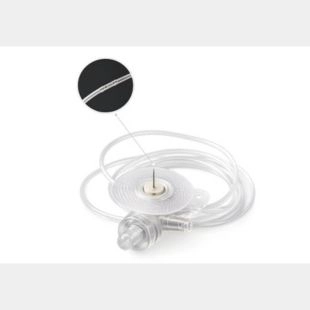
  • Insulin needles
  • Hearing components
  • Instrument tips

Aerospace and Defence

  • turbine blades
  • combustion chambers
  • fuel nozzles
  • satellite components
  • Aerospace components- Made in India

Automotive

  • Fuel injector nozzles
  • ABS housings
  • Airbag components
  • Emission control systems
  • Effusion holes

Semiconductors & electronics

  • PCB
  • Blind and buried vias
  • Flex circuit drilling
  • packaging
  • MEMS

Watchmaking & Jewelery

  • Watch holes
  • Dial perforations
  • Micro engraving and drilling

Science and Research

  • Microscope apertures
  • Ferrule holes

6 How is laser micro-drilling different from mechanical drilling?

Ans: The Fundamental Difference In Mechanical drilling process , the material is removed by physical contact with a tool. Manual micro drilling process is limited by what the tool can physically reach, withstand, and cut. Laser drilling is a contactless process in which the material is removed by heating and vaporisation. There is no tool, no contact, no physical size limit imposed by tooling.

7 Can laser micro-drilling be used on medical implants and tubes?

Ans: Application of laser drilling on implants and tubes is the pinnacle of micromachining using laser engineering.

Laser micro drilling application on Implants

  • Bone implants
  • Vascular stents
  • Orthopaedic screws

Laser micro drilling application on medical tubes

  • Multi-Lumen Catheters
  • Hypo tubes
  • Hypo tubes

8 What is the scope of Medical device manufacturing in India?

Ans: Medical device manufacturing is receiving a strong push from PLI schemes to invest in domestic production. Markolasers are being used on a massive scale within the sector, promoting “Made in India”.

9 What is the difference between laser drilling and laser cutting?

Ans: Markolaser Laser drilling uses stationary pulses for microscopic holes (5 to 500 microns) into one spot. Laser cutting moves the laser beam along a programmed path to cut custom profiles, smooth contours, and larger geometric shapes (greater than 1–2 mm).

When to Choose Laser Drilling

  • Microscopic Scale: Best for making tiny, repetitive holes ranging from 5 microns to 500 microns.
  • High Aspect Ratio: Ideal when you need a deep hole relative to its small diameter.

When to Choose Laser Cutting

  • Custom Geometries: Best for tracing intricate profiles, complex shapes, or continuous paths.
  • Larger Hole Diameters: Preferred when feature or hole diameters are greater than 1–2 mm.
  • Premium Edge Quality: Ideal when your part requires perfectly straight side walls with zero tapering.

Want to see the drilling tolerances Markolaser can offer on Your part , before you commit to a Markolaser micro drilling machine ?

Send a sample. We'll drill it.

Contact us